
Sole Trader vs Limited Company: Which Is Right for Your UK Business in 2026?
Quick answer: Choose sole trader if you want simple admin, low setup costs and you're earning under around £30,000 a year in profit. Choose a limited company if you want limited liability, you're earning more than around £30,000 in profit, you sell to corporate clients, or you plan to take on investment. You can switch from sole trader to limited company later, but getting the choice roughly right from the start saves money and admin.
Introduction
Of all the early decisions a new UK founder makes, "sole trader or limited company?" is probably the one most often made on a hunch. Friends say one thing, the internet says another, your accountant (if you have one yet) says it depends.
It does depend, but not on as many things as you'd think. Once you understand how each structure handles tax, liability and admin, the right call usually becomes obvious within an hour. This guide is built to get you there.
A note up front: there is no objectively "better" structure. There's only the structure that fits where your business is now and where you realistically expect it to be in 12–24 months. The same person, doing the same work, could be better off as a sole trader this year and a limited company next year. That's normal.
The Two Structures, Briefly Explained
Sole trader
A sole trader is a self-employed individual who runs their business as themselves. Legally, there is no separation between you and the business - you are the business. Your business income is your personal income, your business debts are your personal debts and you pay tax on profits via Self Assessment.
Roughly 3.1 million people in the UK are registered as sole traders, making it the most common business structure in Britain.
Limited company
A limited company is a separate legal entity, distinct from the people who own and run it. You become a director (and usually a shareholder) of a company that has its own legal identity, its own bank account, its own tax bills and its own liabilities.
There are over 5 million active limited companies on the Companies House register. Most are small - single-director companies are the norm.
The rest of this article walks through where these two structures actually differ in practice.
Side-by-Side Comparison
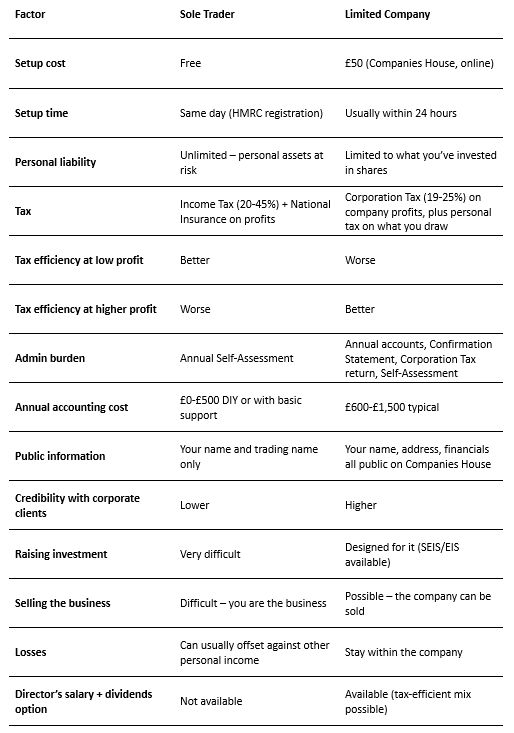
That table is the short version. The next sections explain why each row matters and how to weight them for your situation.
Tax: Where the Real Difference Lies
Tax is the factor founders agonise over most. Often unnecessarily - for many small businesses, the structures end up costing similar amounts of tax. It's other factors (liability, admin, credibility) that should drive the decision. Still, here's how the maths actually works.
How sole traders are taxed
A sole trader's profit (income minus allowable expenses) is added to any other personal income and taxed at standard UK Income Tax rates:
-
Personal Allowance (currently £12,570): 0%
-
Basic rate (£12,571–£50,270): 20%
-
Higher rate (£50,271–£125,140): 40%
-
Additional rate (over £125,140): 45%
On top of that, sole traders pay National Insurance Class 4 contributions on profits between roughly £12,570 and £50,270 (currently 6%) and 2% on profits above that. Class 2 NI was abolished from 6 April 2024 for most sole traders.
Everything is declared and paid through Self Assessment, due 31 January each year.
How limited companies are taxed
A limited company pays Corporation Tax on its profits:
-
19% on profits up to £50,000
-
25% on profits over £250,000
-
A tapered rate (marginal relief) between £50,000 and £250,000
-
After Corporation Tax, what's left is the company's money - not yours. To get money out of the company personally, you typically use a combination of:
-
Salary (taxed via PAYE - Income Tax and National Insurance).
-
Dividends (paid from post-tax company profits, taxed at lower rates - 8.75% basic, 33.75% higher, 39.35% additional - with a £500 annual dividend allowance).
A common setup for small limited company directors: take a small salary below the National Insurance threshold, then top up with dividends. This is more tax-efficient than taking everything as salary, but the gap has narrowed in recent years as dividend tax rates have risen and allowances shrunk.
Worked example: £25,000 profit
A founder making £25,000 profit a year, with no other income:
-
Sole trader: Income Tax of about £2,486 + Class 4 NI of about £746 = roughly £3,232 total.
-
Limited company: Corporation Tax of £4,750 on the £25,000 profit, leaving £20,250. Then personal tax on however that's drawn - broadly similar to the sole trader bill, perhaps slightly worse once you add accounting fees.
At this level of profit, sole trader usually wins on simplicity and cost.
Worked example: £60,000 profit
The same founder making £60,000 profit:
-
Sole trader: Income Tax of about £11,432 + NI of about £2,452 = roughly £13,884 total.
-
Limited company: Corporation Tax of about £11,400, with the remainder drawn as a tax-efficient salary + dividends mix typically resulting in total combined tax of around £12,000–£13,000 depending on exactly how it's structured.
At this level, limited company structures start pulling slightly ahead and the gap widens as profits grow.
These are illustrative. The actual figures depend on your exact circumstances, other income, pension contributions and changing tax rules. Run your numbers through a specific calculator or, better, get a qualified opinion before deciding on the basis of tax alone.
Liability: What's at Stake If Things Go Wrong
This is the factor most under-weighted by new founders and the one that catches them out hardest when it matters.
Sole trader: unlimited personal liability
As a sole trader, your business and your personal finances are legally the same. If your business:
-
Can't pay a supplier - they can come after your personal assets.
-
Gets sued by a customer - your house and savings are exposed.
-
Goes bust owing HMRC - HMRC pursues you personally.
For low-risk businesses (a freelance writer, a tutor, a virtual assistant), this is mostly theoretical. For businesses giving advice, selling products that could cause harm, signing meaningful contracts or holding large amounts of customer money - it's a real and underrated risk.
Insurance helps, but doesn't cover everything. Professional indemnity insurance covers professional mistakes; it doesn't cover, for example, you signing a supplier contract you can't fulfil.
Limited company: liability limited to your investment
A limited company creates a legal wall between you and the business. If the company fails:
-
Creditors pursue the company, not you personally.
-
The most you can lose is what you've put into the company (the value of your shares, typically £1–£100).
There are exceptions - directors can be held personally liable for wrongful trading, fraud, unpaid PAYE/NI in some circumstances and personal guarantees they've signed for business loans. But the default position is meaningful protection.
For most service businesses making sales over a few thousand pounds or any business with real downside risk, the liability protection alone often justifies incorporating.
Admin: How Much Paperwork Are You Signing Up For?
This is the factor most under-weighted in the opposite direction - new founders often assume limited company admin is a nightmare. It's not as bad as the reputation, but it is meaningfully more than sole trader admin.
Sole trader annual admin
-
Self Assessment tax return - once a year, by 31 January.
-
Keep records of income and expenses for at least 5 years and 10 months after the tax year.
-
VAT returns if VAT-registered (quarterly, via Making Tax Digital).
That's it. A reasonably organised sole trader can handle their own Self Assessment with software like FreeAgent or QuickBooks. Many never need an accountant.
Limited company annual admin
-
Annual accounts filed with Companies House (deadline depends on accounting period - usually 9 months after year-end).
-
Confirmation Statement filed annually with Companies House (currently £34 online).
-
Corporation Tax return (CT600) filed with HMRC within 12 months of year-end.
-
Personal Self Assessment if you're a director taking salary/dividends.
-
PAYE returns if you take a salary.
-
VAT returns if VAT-registered.
-
Statutory registers (of members, directors, persons with significant control) maintained.
Most directors pay an accountant to handle the company side - £600–£1,500 a year is typical for a small limited company. DIY is possible but more error-prone than for sole traders and the penalties for late or wrong filings are substantial.
Practical translation
If you hate admin and the difference in tax efficiency at your profit level is small, sole trader is genuinely the kinder option. If you're happy to either learn the limited company admin or pay an accountant to handle it, the additional burden is real but manageable.
Credibility and Growth Potential
This is the factor most people don't realise matters until they hit it.
Working with corporate clients
Many UK corporates and public sector buyers will only work with limited companies. Some won't even put a sole trader on their supplier list. Others will, but invoice processing is slower or terms are worse.
If you sell, or want to sell - to mid-sized companies, large enterprises or government, incorporating signals you're a serious operator. Fair or not, it matters.
Raising investment
Outside investment - angels, VCs, even friends-and-family rounds, essentially requires a limited company. Investors take shares; you can't issue shares as a sole trader.
The two major UK schemes that make small business investment attractive - the Seed Enterprise Investment Scheme (SEIS) and the Enterprise Investment Scheme (EIS) - are only available to limited companies.
If you'll ever want external capital, you'll need to incorporate before raising. Doing it before you actually need the money is much cleaner than scrambling mid-conversation.
Selling the business one day
A sole trader can sell their assets (the equipment, the customer list, the brand) but can't really sell the business - because the business is them. A limited company can be sold as a going concern. The buyer takes over the shares; the business continues.
For most founders this is a distant consideration. But if you're building something with a view to an exit, even years away, the structure matters.
Hiring
Both structures can hire employees. But limited companies have a clearer framework for staff equity (share options, EMI schemes for tax-efficient employee share grants) which sole traders simply can't offer.
The Profit Threshold: When Limited Starts to Make Sense
There's no single magic number, but a rough rule that's served thousands of UK founders well:
-
Under £30,000 annual profit: sole trader is usually simpler and similarly cost-efficient.
-
£30,000–£50,000 annual profit: the tax efficiency starts tipping toward limited company, but not dramatically. Other factors (liability, credibility) often matter more than the tax saving.
-
£50,000+ annual profit: limited company is usually meaningfully more tax-efficient, and the admin overhead is justified by the savings.
These thresholds assume you'd be drawing most of the money personally. If you're reinvesting profits back into the business - keeping them inside a limited company at 19–25% Corporation Tax - the threshold for incorporation drops, sometimes substantially.
A common pattern: a side hustle stays a sole trader until it consistently makes £25,000–£30,000+ profit a year, then incorporates when full-time. That sequence usually optimises both tax and admin.
Privacy Considerations
This one surprises people.
Sole trader: relatively private
Your business income is reported on your personal Self Assessment, which is private to you and HMRC. Your trading name, if you use one, is on your invoices but not on a public register.
Limited company: substantially public
When you incorporate, the following becomes publicly available on the Companies House website, free to anyone with the URL:
-
Your name, date of birth (month and year), nationality.
-
Your registered office address.
-
Your service address (which can be different from your home, but is still public).
-
The names and details of other directors and persons with significant control.
-
Annual accounts (level of detail depends on company size - most small companies file abbreviated accounts).
-
Mortgages and charges over company assets.
Most founders adjust to this quickly. But if your business is sensitive - you're leaving an employer who might object, you have personal safety concerns, or you simply value privacy - it's worth knowing what's about to become public before you incorporate.
You can use a registered office service to keep your home address off the public register. Most company formation providers (including Business Starter) offer this.
When to Choose Sole Trader
Sole trader is the right call when most of these are true:
-
You expect profits under around £30,000 a year for the foreseeable future.
-
Your business has low liability risk - you're not giving advice that could cause loss, selling products that could cause harm or signing meaningful contracts.
-
You sell mainly to consumers or to small businesses that don't care about your structure.
-
You want minimum admin and don't want to learn limited company filing requirements.
-
Privacy matters to you - you'd rather your details didn't appear on a public register.
-
You're testing an idea and aren't sure it'll work yet.
-
You're starting as a side hustle alongside employment.
Most UK freelancers, consultants, tutors, virtual assistants and small creative businesses start and often stay as sole traders. There's nothing inferior about it.
When to Choose Limited Company
Limited company is the right call when any of these are true:
-
You expect profits above around £30,000 a year (and especially above £50,000).
-
Your business has real liability risk - professional advice, products, large contracts, holding client money.
-
You sell, or want to sell, to corporate or public sector clients.
-
You plan to raise investment, take on co-founders or one day sell the business.
-
You want the clearer separation between personal and business finances.
-
You want to reinvest profits inside the business at the lower Corporation Tax rate.
-
The added credibility matters in your sector.
A meaningful number of UK founders incorporate from day one even at low expected profits, simply because the liability protection and credibility are worth the fee and additional admin.
Can You Switch Later?
Yes - and many UK businesses do.
Sole trader to limited company
This is the common direction. You incorporate a new company, transfer the business assets to it (often at book value, with some tax planning around goodwill), close the sole trader registration with HMRC and continue trading under the new entity.
It's not free or instant, there's typically £500–£1,500 of accounting and legal work involved, plus some tax considerations, but it's a routine transaction. Most UK accountants handle it regularly.
Common timing: when annual profits cross £30,000–£50,000 consistently or when a new contract requires limited company status or when you're about to take on investment.
Limited company to sole trader
The reverse is less common, but possible. You'd stop trading through the company, transfer assets out (with tax implications), close the company via voluntary strike-off or members' voluntary liquidation and re-register with HMRC as a sole trader.
This is usually done when a business has shrunk substantially and the limited company admin overhead is no longer worth it.
The practical takeaway
Don't agonise over the choice as if it's permanent. Aim to get it roughly right for the next 12–24 months. If your business grows or changes, change with it.
Not sure which structure fits your business? Business Starter's Business Creator walks you through the decision in five minutes — and if you choose limited, we register your company with Companies House for you, usually within 24 hours. Get started →
Frequently Asked Questions
Is it better to be a sole trader or a limited company in the UK?
Neither is universally better. Sole trader is simpler and cheaper at low profit levels (under around £30,000). Limited company is more tax-efficient at higher profit levels and offers limited liability and more credibility. The right choice depends on profit, risk, sector and growth plans.
At what profit should I switch from sole trader to limited company?
Most UK founders find the switch starts making sense around £30,000–£50,000 annual profit, depending on circumstances. Below this, the tax saving rarely covers the additional admin cost. Above £50,000, the case for incorporation usually becomes clear.
Do limited companies pay less tax than sole traders?
At higher profit levels, yes - moderately. The difference comes from Corporation Tax (19–25%) being lower than higher-rate Income Tax (40%) and from the ability to split income between salary and dividends. At lower profit levels, the difference is small or non-existent once accounting fees are included.
Can I be a sole trader and a limited company director at the same time?
Yes. Many UK founders run a sole trader business alongside a separate limited company in a different area. They're treated as separate businesses for tax purposes.
Is it harder to get a business loan as a sole trader?
Slightly. Some lenders prefer limited companies because of the clearer financial reporting. But most UK business lenders, including the Start Up Loans scheme, accept both structures.
Does a limited company need an accountant?
Not legally, but in practice almost all UK limited companies use one. The combination of annual accounts, Confirmation Statements, Corporation Tax returns and PAYE means most directors find it more cost-effective to pay £600–£1,500 a year for an accountant than to risk filing errors and penalties.
Can I run a limited company from my home address?
Yes. Many UK limited companies use the director's home address as their registered office. The trade-off is that the address becomes public on the Companies House register. A registered office service (£30–£100/year) keeps your home address private.
Final Thoughts
Most of the energy spent debating sole trader vs limited company is wasted. The structures aren't dramatically different in tax cost for most small businesses. The factors that actually matter - liability protection, credibility with the clients you want to win, admin tolerance and growth plans - are easier to weigh once you've stopped treating the decision as a tax optimisation puzzle.
If your business is small, low-risk and consumer-facing, start as a sole trader. If it's bigger, riskier or sells to companies that care about supplier credentials, incorporate. Either way, you can change later. The decision matters, but not as much as actually getting started.
Ready to take the next step? If you're ready to start your limited company, Business Starter sets you up properly from day one. Start here →
-
For expert guides, click here.
This article is for general information only and does not constitute personalised tax or financial advice. UK tax rates, thresholds and rules change at every Budget - please verify figures against current gov.uk guidance, or speak to a qualified accountant, before making structural decisions about your business.