
How to Start a Business in the UK: The Complete 2026 Guide
To start a business in the UK, choose a business structure (sole trader or limited company), register with HMRC or Companies House, open a business bank account, sort out tax and insurance and start trading. The whole process can take as little as 24 hours.
Last year, more than 800,000 new companies were registered with Companies House. Behind every one of those numbers is someone who, at some point, sat exactly where you're sitting now - Googling "how to start a business in the UK" and trying to work out what to do first.
The honest truth is that starting a business in Britain is not difficult. The system is, in global terms, remarkably simple. You can register a limited company online in under 24 hours for £50. You can open a business bank account from your phone the same afternoon. You can be legally trading by tomorrow.
What's difficult is knowing the right order, the right structure and the bits people don't tell you until you've already got them wrong. That's what this guide is for.
We've structured it as the step-by-step you'd get from a friend who's done this five times and has nothing to sell you on the way through. Every section is reviewed by a qualified UK adviser before it goes live and every figure here is checked against current HMRC and Companies House guidance. Where the rules might change - tax thresholds, fee increases - we say so.
Let's start at the beginning.
Before You Register - Is Your Business Idea Ready?
Most guides skip this step. They shouldn't. The single most expensive mistake a new founder makes isn't choosing the wrong company structure or missing a tax deadline - it's incorporating and spending six months building something nobody wanted to pay for in the first place.
Before you register anything, you want to be reasonably confident on three things.
Validate your idea before you spend a penny
There's a simple three-question test we use with every new Business Starter customer:
-
Is there someone who will pay for this? Not "would this be useful to people" - that's an opinion. Has anyone actually offered you money, or said they would?
-
Can you reach them affordably? A brilliant product nobody can find isn't a business.
-
Can you deliver it profitably? Once you account for time, materials and overheads, is there meaningful margin left?
If you can't answer all three with a confident yes, the next month is better spent validating than incorporating. Talk to five potential customers. Not friends or family - actual buyers. Ask what they currently do about the problem you're solving, what they pay and what would make them switch. You'll learn more in those five conversations than in five hundred hours of planning.
Should you start full-time or as a side hustle?
There's no single right answer, but the framing matters.
Start full-time if: You've already validated demand, you have 6–12 months of personal runway saved and the business genuinely requires full-time attention from day one (you can't deliver it evenings and weekends).
Start as a side hustle if: You're still validating, your current job covers your living costs, the business can be tested at small scale and your employment contract permits outside work (check it - most UK contracts do, but some restrict competing activity).
Side hustles aren't a lesser path. Many of the UK's best-known small businesses spent 18 months as evening projects before their founder went full-time. The optionality is worth more than the urgency.
When NOT to start a business
A guide on starting a business should also be honest about when not to. Don't start a business if:
-
You have no financial buffer and are relying on the business to pay your rent next month. Founders making decisions from financial panic make worse decisions.
-
You're starting because you hate your current job and want out. Starting to escape tends to produce poorly thought-through businesses. Solve the job problem first.
-
You haven't spoken to a single potential customer. Conviction without evidence is not a strategy.
If none of those apply to you, you're ready to move on.
Choose Your Business Structure
This is the first formal decision you'll make. The structure you choose affects how you pay tax, how much paperwork you have, whether your personal assets are on the line if things go wrong and how credible you look to customers and investors.
There are four common structures in the UK.
The four main UK business structures
Sole trader. You and the business are legally the same entity. Simplest setup. You pay Income Tax and National Insurance on your profits via Self Assessment.
Limited company. The business is a separate legal entity from you. You're a director and (usually) a shareholder. The company pays Corporation Tax; you pay personal tax on whatever you draw as salary or dividends.
Partnership. Two or more people share ownership and responsibility, with profits split between them. Each partner pays Income Tax on their share.
Limited Liability Partnership (LLP). A hybrid - partners share profits but have limited personal liability. Common in professional services like law and accountancy.
Sole trader vs limited company: the honest comparison
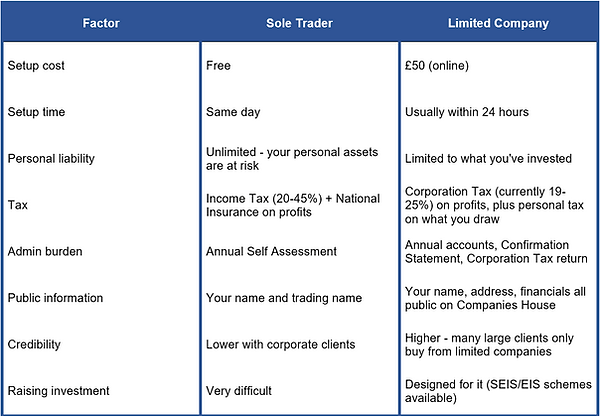
For 90% of readers, the real decision is sole trader vs limited company. Here's how they actually compare:
When a limited company is the right choice
A limited company usually makes sense when any of these are true:
-
You expect to make more than around £30,000 a year in profit (the tax efficiency starts working in your favour above this point - though the exact threshold depends on your circumstances).
-
You're providing services where a client could plausibly sue you. The limited liability matters.
-
You plan to take on investment or co-founders.
-
You're selling to corporate clients who prefer to buy from limited companies.
-
You want to build something you might one day sell.
When to stay a sole trader
Sole trader is the right call when:
-
You're testing an idea and want minimum admin.
-
You're a freelancer or consultant earning under around £30,000 a year.
-
Your business carries low liability risk (you're not giving advice that could cause loss or selling products that could cause harm).
-
Privacy matters to you - limited company information is fully public.
Register Your Business
Once you've chosen a structure, registering is the easy part. The exact process depends on what you've chosen.
Registering as a sole trader with HMRC
Sole traders register for Self Assessment with HMRC. You must register by 5 October following the end of the tax year in which you started trading. The UK tax year runs from 6 April to 5 April.
What you'll need: National Insurance number, personal details, business name (which can just be your own name) and trade description.
How: Online at gov.uk via "Become a Sole Trader." HMRC sends you a Unique Taxpayer Reference (UTR) by post within around 10 working days.
Cost: Free.
Timeline: Registration is same-day; UTR arrives 10 working days later.
Registering a limited company with Companies House
Limited company registration ("incorporation") is done with Companies House.
The steps:
-
Choose a company name. It must be unique and not contain restricted words (more on this below).
-
Choose a registered office address. This is the official address for legal correspondence and is public.
-
Appoint at least one director. Directors must be 16 or over.
-
Decide on shareholders and share capital. Most small companies start with one shareholder (you) and one £1 share.
-
Write a memorandum and articles of association. Companies House provides standard templates - use these unless you have a specific reason not to.
Timeline: Usually within 24 hours; sometimes the same day.
Choosing a company name: the rules
Your company name must be unique on the Companies House register and cannot:
-
Be the same as, or too similar to, an existing registered name.
-
Contain "sensitive" or "restricted" words (e.g. "Bank," "Royal," "Chartered," "British") without permission.
-
Be offensive or imply a connection to the government without authorisation.
It's worth checking trade mark availability at the same time. A name that's available on Companies House but already trade-marked can cause expensive problems later. Free search at the Intellectual Property Office's trade mark database.
Registered office address: can it be your home?
Yes, many UK companies use the founder's home address as the registered office. But two things to know:
-
It becomes public. Anyone can search Companies House and find your address.
-
It must be in the UK and in the same country as the company is registered (England & Wales, Scotland, or Northern Ireland).
If privacy matters, you can use a registered office service. These typically cost £30–£100 a year. Business Starter can help source one, if needed.
Choosing your SIC code
Every UK company needs at least one Standard Industrial Classification (SIC) code describing its main activity. This is for statistical purposes, but it also affects:
-
Whether banks and insurers will work with you.
-
Which industry data Companies House attributes to you.
-
How HMRC categorises your business.
Pick the code that most accurately describes what you actually do. If you do several distinct things, you can list up to four codes. The full list is at gov.uk under "Standard Industrial Classification (SIC) Codes."
Business Starter registers your limited company with Companies House for you, picks the right SIC code and sets you up with a registered office address - usually within 24 hours. Get started →
Sort Out Tax and HMRC
Tax is where most new founders feel out of their depth. The good news: for a small UK business, the rules are simpler than they look.
Which taxes will your business pay?
It depends on your structure and turnover:
-
Sole traders pay Income Tax and National Insurance via Self Assessment.
-
Limited companies pay Corporation Tax on profits and as a director you pay personal tax on whatever salary or dividends you draw.
-
Both may need to register for VAT if turnover exceeds £90,000 (the current threshold, set on 1 April 2024).
-
Both need to register for PAYE if they pay employees (including paying themselves a director's salary).
-
Registering for Self Assessment (sole traders)
Done at gov.uk. You need to register by 5 October following the tax year you started trading. Self Assessment returns are due by 31 January each year, with any tax owed payable by the same date.
Corporation Tax registration (limited companies)
When you incorporate, HMRC is automatically notified. Within 3 months of starting to trade, you must tell HMRC your company is active so they can set up your Corporation Tax. Returns are filed annually based on your accounting period (usually 12 months from incorporation). Corporation Tax is currently 19% for profits under £50,000, tapering to 25% for profits over £250,000.
Do you need to register for VAT?
You must register if your taxable turnover in any rolling 12-month period exceeds £90,000. You can register voluntarily below this threshold.
Reasons to register voluntarily:
-
You sell mainly to other VAT-registered businesses (they can reclaim the VAT, so it doesn't hurt them).
-
You want to reclaim VAT on substantial business purchases.
-
VAT registration adds a small credibility signal.
Reasons not to:
-
You sell mainly to consumers, who can't reclaim VAT - registration effectively makes you 20% more expensive.
-
The admin overhead isn't worth it at your scale.
-
PAYE - only if you have employees
PAYE (Pay As You Earn) is how HMRC collects Income Tax and National Insurance from employee wages. You'll need to register for PAYE if:
-
You have employees earning over the Lower Earnings Limit (£123/week in the 2024–25 tax year).
-
You're a director of a limited company paying yourself a salary above this amount.
Many small limited company directors take a small salary just below the NI threshold and the rest as dividends. Whether this is optimal for you depends on your circumstances - this is the kind of question to put to an accountant or our advice team.
Making Tax Digital: what every new business needs to know
Making Tax Digital (MTD) is HMRC's programme to move all tax record-keeping and reporting onto compatible digital software. It's already in place for VAT-registered businesses. MTD for Income Tax Self Assessment (MTD ITSA) is being rolled out for sole traders and landlords with income above set thresholds - the timeline keeps moving but currently begins April 2026 for those earning over £50,000 and April 2027 for those over £30,000.
Practical translation: keep digital records from day one. Don't wait. Software like Xero, QuickBooks or FreeAgent handles this automatically.
Important: Tax thresholds and rules change at every Budget. This section was last reviewed on 8th May 2026. For decisions specific to your business, speak to a qualified adviser or get one through a Business Starter Advice Plan.
Open a Business Bank Account
Do you legally need a separate business account?
Limited companies: yes. A limited company is a separate legal entity and must have its own bank account.
Sole traders: no, but you should anyway. There's no legal requirement, but mixing personal and business finances creates a Self Assessment nightmare and makes you look amateurish to anyone who sees your invoices.
What documents you'll need:
For most UK business bank accounts:
-
Photo ID (passport or driving licence)
-
Proof of address (recent utility bill or bank statement)
-
Companies House registration certificate (limited companies)
-
National Insurance number
-
Business plan or trading description (some banks ask, most don't anymore)
-
Traditional banks vs digital business banks
The UK is unusually well-served on this front. Your main options:
Digital-first business banks (Tide, Starling Business, Mettle, Revolut Business, Monzo Business): same-day opening, app-first, low or no monthly fees, excellent for early-stage businesses. Limitations on cash deposits.
Traditional banks (Barclays, HSBC, Lloyds, NatWest, Santander): more comprehensive services (cash handling, business loans, merchant services), but slower onboarding (1–4 weeks), often with monthly fees after an introductory period.
For 80% of new UK businesses, a digital business bank is the right starting point. You can switch later.
How long does it take?
-
Digital banks: Same day, often within an hour, all done via Business Starter.
-
Traditional banks: Typically 1–4 weeks, often with a branch appointment.
What to look for
-
Monthly fees (and what triggers them).
-
Free transaction allowance.
-
Foreign exchange handling (matters even for UK businesses - many of your suppliers may be overseas).
-
Integration with accounting software.
-
Cash deposit options if your business handles physical cash.
Get the Right Insurance
Insurance is the bit founders most often skip and most often regret.
Which insurance is legally required?
Employers' Liability Insurance. If you employ anyone (other than close family members, in some cases), this is legally required, with a minimum cover of £5 million. The fine for not having it is up to £2,500 per day.
Sector-specific requirements. Some regulated sectors (financial advice, healthcare, construction) require professional indemnity or specific cover by law or to maintain professional body membership.
Which insurance is strongly recommended
-
Public Liability: Covers claims from members of the public for injury or property damage. Essential if customers visit your premises or you visit theirs.
-
Professional Indemnity: Covers claims that your professional advice or service caused loss. Essential for consultants, designers, accountants, anyone giving advice.
-
Product Liability: If you make or sell physical products.
-
Cyber Insurance: Increasingly essential if you hold customer data and you almost certainly do.
-
Business Contents: If you have premises, equipment or stock.
How much does it cost?
A typical UK micro-business pays £150–£500 a year for a combined small business policy covering public liability, professional indemnity and basic contents. Specialist sectors pay more.
Set Up Your Finances and Bookkeeping
What records you must keep by law
HMRC requires you to keep:
-
Limited companies: All financial records for at least 6 years from the end of the company financial year.
-
Sole traders: All records for at least 5 years after the 31 January Self Assessment deadline.
Records include: sales invoices, purchase receipts, bank statements, mileage logs, VAT records (if registered) and PAYE records (if you employ anyone).
Bookkeeping software for UK small businesses
The four main UK options:
-
Xero: Best all-rounder for limited companies; clean interface; strong accountant ecosystem.
-
QuickBooks: Strong for sole traders and small limited companies; excellent mobile app.
-
FreeAgent: Free with NatWest, RBS or Mettle business accounts; designed for UK freelancers and small businesses.
-
Sage: Long-established; more comprehensive; can feel overbuilt for very small businesses.
Pick one and stick with it from day one. Switching mid-year is painful.
Do you need an accountant?
DIY is fine if: You're a sole trader with simple income, you use accounting software, and you have time to learn the basics.
Pay for help if: You've incorporated as a limited company (accounts, Confirmation Statements and Corporation Tax returns are easier to get wrong than right), you're VAT registered, you have employees or your time is genuinely worth more than the accountant's fee.
A small limited company accountant typically charges £600–£1,500 a year. If you spend more than two days a year struggling with your books, the maths is clear.
Separating personal and business finances from day one
This is non-negotiable. From the first day you start trading:
-
Use your business bank account for all business income and expenses.
-
Don't pay personal bills from the business account, even "just this once."
-
Pay yourself a clear, traceable amount on a regular schedule.
The cost of unpicking mixed finances at year-end far exceeds the inconvenience of keeping them separate.
Business Starter's Support Plans include bookkeeping help, tax filing reminders, and direct access to qualified UK advisers. Compare plans →
Build Your Brand and Online Presence
You can be legally trading without any of this, but you'll struggle to actually find customers.
Secure your domain name and business email
Even before you launch, buy your domain. Costs £10–£15 a year from registrars like Namecheap, GoDaddy or 123 Reg. While you're there, set up a professional email address (you@yourbusiness.co.uk) via Google Workspace or Microsoft 365 - around £5/month. Using gmail.com or hotmail.com on your business cards instantly signals "amateur."
Build your first website
Your options depend on what you're selling:
-
Service businesses: Wix, Squarespace or WordPress. Budget £0–£300 to launch.
-
E-commerce: Shopify is the default. Budget £25–£100/month.
-
Marketplace listings only: You may not need a website at all initially - Etsy, eBay or Amazon can be enough to start.
Don't spend three months perfecting a website. Launch a credible v1 and iterate.
Set up business social media
Pick the platforms your customers actually use, not the ones you find most fun:
-
B2B services: LinkedIn first, others optional.
-
Consumer products: Instagram and TikTok, possibly Pinterest.
-
Local services: Facebook and Google Business Profile.
Don't try to be everywhere. One platform done well beats five done badly.
Google Business Profile - the highest-ROI free thing you can do
If you serve a local area at all, even partially, set up a Google Business Profile (business.google.com). It's free, takes 20 minutes and gets you into Google Maps results and the local pack on search. For many local businesses this is the single most valuable marketing asset they own.
Basic SEO from day one
Three things every new UK business should do on launch:
-
Add your business to Google Business Profile and request reviews from your first customers.
-
Write descriptive page titles and meta descriptions for every page of your website (most website builders make this easy).
-
Get listed in 5–10 UK directories relevant to your sector. Consistent name, address and phone number across all of them.
Understand Your Legal Obligations
Terms and conditions, privacy policy, cookies notice
If you have a website that does any of the following, you legally need certain documents:
-
Sells anything: Terms and Conditions of Sale.
-
Collects any personal data (even just contact form submissions): Privacy Policy.
-
Uses cookies beyond the strictly necessary: Cookies Notice and consent banner.
Templates are available at Business Creator.
GDPR and data protection in plain English
If your business processes personal data (names, emails, payment details), GDPR applies. The practical requirements:
-
Register with the ICO. Costs £40–£60 a year. Mandatory for most businesses processing personal data.
-
Have a Privacy Policy explaining what data you collect, why and how long you keep it.
-
Only collect what you need.
-
Keep it secure.
-
Honour data subject rights (people can ask what data you hold on them and ask you to delete it).
The ICO website (ico.org.uk) has free guidance specifically for small businesses.
Contracts: with customers, suppliers and freelancers
Every commercial relationship benefits from a written contract. Even simple ones. Especially:
-
Customer contracts that set out payment terms, deliverables and what happens if either side wants to end the relationship.
-
Freelancer contracts that clarify whether they're a contractor (not your employee) - this matters for tax and for employment rights.
-
NDAs before sharing sensitive information.
Intellectual property basics
-
Trade marks protect your brand name and logo. UK trade mark registration costs from £170 and lasts 10 years.
-
Copyright is automatic, it exists from the moment a work is created.
-
Design rights protect the appearance of products.
-
Patents protect inventions, but are expensive and rarely worthwhile for small businesses.
-
If you'll have employees
Employment law is its own world. The essentials:
-
Written contracts are required by law (a statement of employment particulars must be given on or before day one).
-
National Minimum Wage / National Living Wage must be paid.
-
Paid holiday of at least 5.6 weeks per year (including bank holidays).
-
Workplace pension auto-enrolment if you have any qualifying employees.
-
Employer's Liability Insurance (covered above).
Hiring your first employee is the kind of milestone where paying for professional advice up-front saves enormous problems later.
Get Funding (If You Need It)
Not every business needs external funding. Many of the most successful UK small businesses are bootstrapped from revenue. But if yours needs capital:
Bootstrapping vs raising money
Bootstrap if: Your business can become profitable quickly, you want to retain full ownership and you can fund early costs from personal savings or early customer revenue.
Raise if: You need significant up-front investment (e.g. building software, holding stock), you're entering a market where speed matters or you need expertise as well as capital.
UK government grants for new businesses
The UK has hundreds of small business grants, regional and sector-specific. Start at:
-
gov.uk's "Find a grant" service
-
Local Growth Hubs (each English region has one; Manchester and Greater Manchester have their own)
-
Innovate UK for innovation-focused grants
-
Sector-specific bodies for your industry
Grants are non-dilutive (you don't give up equity) but competitive and admin-heavy.
The Start Up Loans scheme
A government-backed loan scheme offering up to £25,000 per founder (up to £100,000 per business with multiple co-founders), at a fixed 6% interest rate, with 1–5 year terms and free business mentoring included. Run by the British Business Bank. One of the best small business funding products in the UK.
SEIS and EIS: tax-advantaged investment
If you're raising equity from individual investors (angels), the Seed Enterprise Investment Scheme (SEIS) and Enterprise Investment Scheme (EIS) give those investors substantial tax relief, which makes them much more likely to invest. SEIS allows investors up to 50% Income Tax relief on investments up to £200,000. EIS allows 30% relief on larger investments.
These are powerful but technical. Getting them set up correctly is worth professional help.
Other options
-
Business credit cards and overdrafts - for short-term working capital, not long-term funding.
-
Crowdfunding - Crowdcube and Seedrs for equity, Kickstarter for product pre-orders.
-
Angel investment and VC - realistic at scale, but only relevant for businesses with clear high-growth potential. Most UK small businesses are neither and that's fine.
Your First 90 Days of Trading
Most guides stop at "you're registered, good luck." The first 90 days are where most preventable failures actually happen.
Week 1: foundations
-
Confirm bank account, accounting software and bookkeeping system are working.
-
Send your first invoice - even if it's small. The first invoice clarifies everything else.
-
Tell your network you've started. The single highest-ROI marketing of your first month is people you already know.
-
Update LinkedIn and other professional profiles.
Month 1: first customers
-
Focus on closing 3–5 customers. Not 50. Not a launch event. Three to five real, paying customers.
-
For each, ask what made them say yes. Write it down. This is your real marketing plan.
-
Test your delivery process. Where does it break?
Month 2: systems and processes
-
Document what works. Even a simple Google Doc.
-
Set up a basic CRM (even a spreadsheet is fine to start).
-
Automate the boring stuff - invoice reminders, calendar bookings, email replies.
Month 3: review and adjust
-
What's working? Do more of it.
-
What's not? Stop doing it. Don't sunk-cost into a tactic that isn't returning.
-
Look at your numbers honestly. Revenue, costs, hours worked. If the unit economics aren't working, find out why now.
Mistakes founders make in the first 90 days
-
Spending too much on a logo, business cards and "stuff" before they have customers.
-
Building a website for three months instead of getting in front of buyers.
-
Hiring too early.
-
Discounting to win the first sale. That price becomes the reference price.
-
Working alone in isolation. Find one peer founder, or join a community.
How Much Does It Cost to Start a Business in the UK?
The honest answer: less than you think to start, more than you think to sustain.
Minimum cost (sole trader, no premises): under £100
You can genuinely start a UK service business this cheaply.
Limited company starter cost: £200–£500
Realistic year-one costs: £1,000–£5,000+
Once you add a basic website, some marketing, a small amount of stock or equipment, professional fees and a software stack, most UK small businesses spend £1,000–£5,000 in their first year. Sectors that need premises, inventory or regulatory licensing will spend more.
Where founders overspend
-
Premium offices they don't need.
-
Premium software stacks when free or cheap tools would do.
-
Logos, branding and stationery before they have customers.
-
Lawyers and accountants for everything, when off-the-shelf templates and software would handle 80% of it.
Where founders underspend (and regret it)
-
Insurance. One mid-sized claim that wasn't covered will outweigh five years of premiums.
-
Proper contracts. Cheap templates that don't fit your business cause expensive disputes.
-
Accounting help at year-end. DIY accounts done wrong cost more to fix than to do right first time.


Common Mistakes New UK Business Owners Make
Twelve specific mistakes we see most often, drawn from working with UK founders:
-
Mixing personal and business finances. Already covered, but bears repeating this is the single most common cause of year-end tax pain.
-
Not putting tax aside. Sole traders especially. The rule of thumb: put 25–30% of every payment into a separate "tax" savings account the day it arrives.
-
Underpricing. New founders almost always charge too little. Doubling your prices loses 30% of customers and gains 70% revenue. Do the maths.
-
Building before selling. Spending three months on a product nobody has agreed to pay for.
-
Ignoring HMRC letters. They don't go away. They get worse.
-
Hiring an employee before you genuinely need one full-time. Freelancers and contractors first, employees later.
-
Not having a written contract. Then arguing with a customer who interprets the deal differently to you.
-
Using personal email on business cards. Reads as amateur. Costs £5/month to fix.
-
Skipping insurance to save £200. Then losing £20,000 when something goes wrong.
-
Not registering with ICO when you process personal data. Cheap fix, expensive ignored.
-
Trying to do everything. You're the founder. Your job is the strategy, the sales, and the things only you can do. Outsource the rest.
-
Not asking for help early enough. Almost every problem on this list is one a peer, mentor or adviser has seen before. Ask.
How Business Starter Can Help
We built Business Starter because we kept watching capable founders waste their first six months on paperwork, research and avoidable mistakes and lose momentum, money or both in the process.
The platform brings the entire setup process into one guided web app. You answer a short series of questions about your business and Business Starter handles the rest for you, every step in this guide:
-
Company registration with Companies House, including name check, SIC code selection and registered office service.
-
Business bank account introductions with our banking partners, accelerating account opening.
-
Website and social media setup, configured for your business from day one.
-
HMRC and tax registrations in the right order, at the right time.
-
Ongoing advice and support subscriptions giving you direct access to qualified UK specialists in finance, tax, legal and marketing - at a fraction of the cost of hiring them independently.
-
Two routes, depending on how much you want to hand over:
-
Advice Plans for founders who want to do the work themselves but with expert guidance on call.
-
Support Plans where our team takes on the heavy lifting - legal, finance, admin and compliance - so you can focus on your product.
Start your UK business with Business Starter. Register your company, open a bank account and get expert support — all from one platform. Get started →
Frequently Asked Questions
How much does it cost to start a business in the UK?
A sole trader can start for under £100. A limited company can be registered for £50 with Companies House. Realistic first-year costs including insurance, software, basic marketing and professional fees typically range from £500 to £5,000 depending on sector.
Can I start a business with no money in the UK?
Yes - many UK service businesses (consultancy, freelance writing, tutoring, design) can be started with effectively zero cost beyond HMRC registration, which is free for sole traders. The constraint is usually time, not money.
Do I need to register my business in the UK?
Sole traders register with HMRC for Self Assessment by 5 October following the tax year they started trading. Limited companies must register with Companies House before trading. Partnerships register with HMRC.
How long does it take to register a UK limited company?
Online registration with Companies House usually completes within 24 hours, often the same day. Paper applications take 8–10 days.
Can I start a business while employed full-time?
Almost always yes, but check your employment contract for clauses about outside work or competing activity. Tax-wise, side hustle income must be declared via Self Assessment. The £1,000 trading allowance means small side income may not need to be reported.
Do I need a business plan to start a UK business?
Not legally. But you do need one if you're applying for a bank loan, the Start Up Loans scheme or any grant. Even without external funding, a simple one-page plan helps you think clearly about what you're actually doing.
What's the easiest business to start in the UK?
Service-based businesses with low upfront cost (freelance writing, consulting, tutoring, virtual assistance, basic web design) have the lowest barriers - you can be trading in days for under £100.
Do I need a separate bank account as a sole trader?
Not legally, but strongly recommended. Mixing personal and business finances creates Self Assessment headaches and looks unprofessional.
When do I need to register for VAT in the UK?
When your taxable turnover in any rolling 12-month period exceeds £90,000 (the current threshold from 1 April 2024). You can register voluntarily below this threshold if it suits your business.
Can I run a UK business from home?
Yes. Most UK micro-businesses are run from home. You may need to inform your mortgage lender or landlord, check your home insurance covers business use and potentially pay business rates if you've converted a significant part of your home, but for most home-based businesses none of these are obstacles.
For expert guides, click here.
This article is for general information only and does not constitute personalised legal, tax or financial advice. UK tax thresholds, fees and regulations change regularly - please verify the figures against current gov.uk guidance or speak to a qualified professional, before making decisions.